By Helen Schlimm, Research Specialist, UW-Madison Center for Limnology
Urban ponds are an ongoing research focus for the Wilkinson Lab at the UW-Madison Center for Limnology. The lab is trying to understand how ponds function from an ecological point of view. What factors affect their biology and chemistry, and do ponds act similarly?
To help address these questions, the lab launched the Community Water Monitoring Network (CWMN) in 2022. This community science program engages around 30 volunteer monitors, “Pond Pals,” in year-round data collection at 10 sites in the Madison-Middleton area. Pond Pals record observations, take water measurements, and collect samples for lab analysis. Long-term monitoring is a crucial part of ecosystem science and bolsters the usefulness of the data. For example, CWMN data contributed to the newest City of Middleton Conservancy Lands Plan.
Graber Pond joined the CWMN in the spring of 2024, following a public presentation with the Friends of Pheasant Branch Conservancy. The pond lies west of the Conservancy and falls within its watershed. During high precipitation years, water flows from Graber Pond east into Pheasant Branch Creek and Lake Mendota.
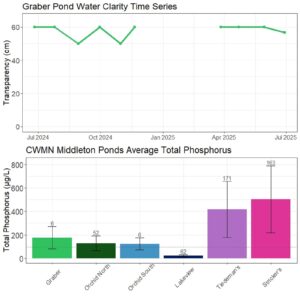
With only one year of data collection, it is difficult to draw firm conclusions about the pond’s current water quality status. However, some initial trends are starting to unfold. Total phosphorus (TP) measurements, an indicator of nutrient levels, classify Graber as a hypereutrophic pond. This means that there is an overabundance of nutrients in the water, which often leads to excess plant and algae growth. Graber’s TP average ranks in the middle when compared to the other Middleton ponds in the CWMN. Hypereutrophic waterbodies are often characterized by a fluorescent green water color with low transparency. Interestingly, Graber’s water stays relatively clear despite the high level of TP (Figure 1).
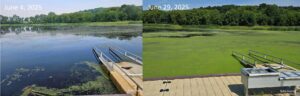
Its clearer water may be linked to the floating carpet of duckweed, a small aquatic plant, that has been observed on the pond for the last two summers (Figure 2). The lab is investigating this connection through the Pond Pals and their ongoing monitoring; stay tuned for updates!
To learn more about the CWMN, visit https://cflwaternetwork.limnology.wisc.edu.