
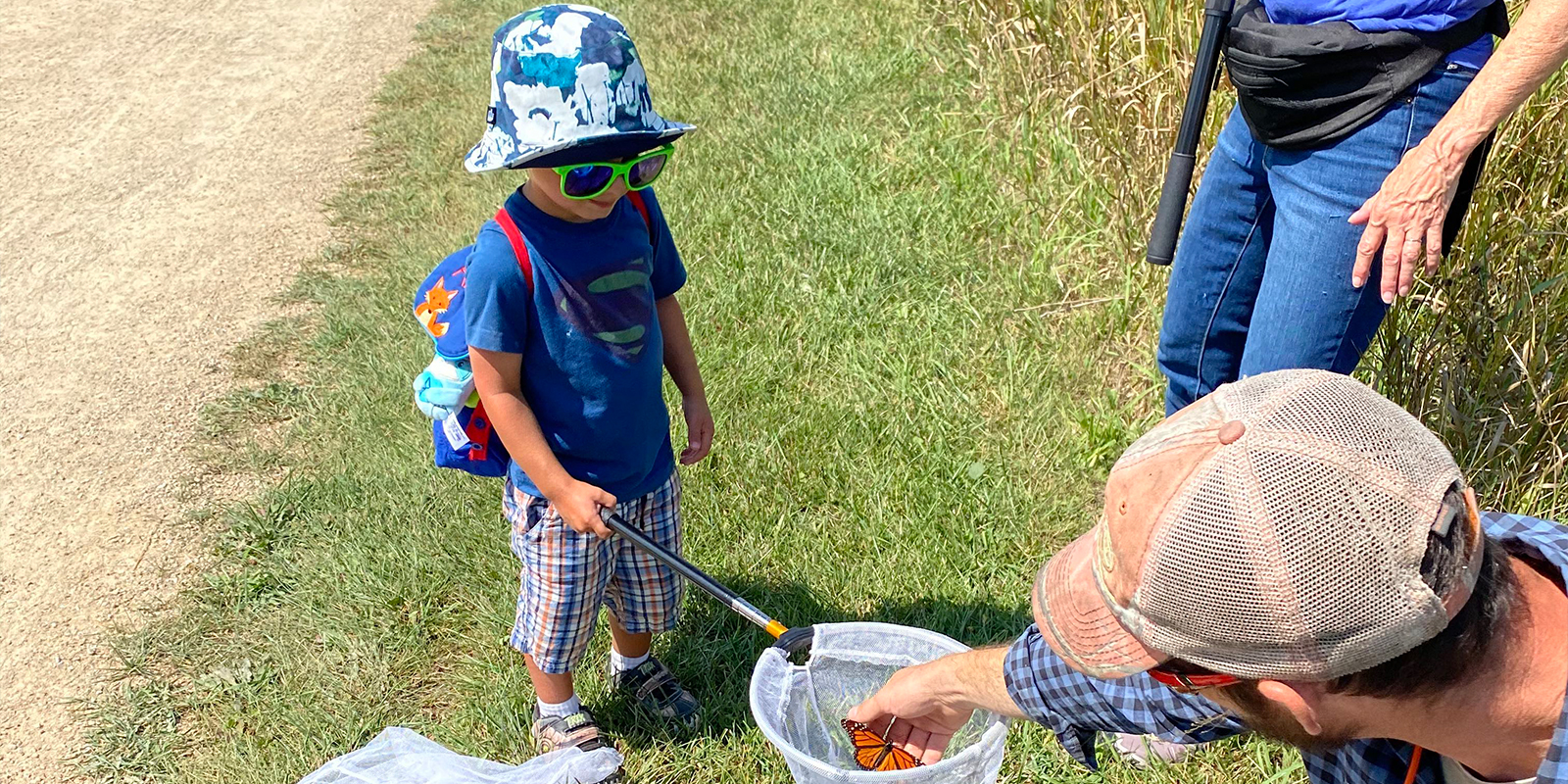
Photo: Chris Kehler
By Carl Sinderbrand, Chair of the Friends of Pheasant Branch Conservancy Governance Committee
For the past several years, the Friends of Pheasant Branch Conservancy has organized monarch butterfly tagging events, through Monarch Watch, an international organization that tracks monarchs’ migration from breeding sites throughout North America to their overwintering sites in the Sierra Madre Mountains in central Mexico. In our latitude, tagging season typically runs from late August through early September.
Monarch tagging has been ongoing since the early 1990s, due to the substantial decline in monarch populations. Recent studies have documented a 22 percent decline in monarch populations in North America during the past 20 years, due in large measure to loss of habitat. Tagging data help scientists identify migration pathways and particularly valuable habitat for the annual migrations.
Our tagging events are always joyful. We catch the butterflies with nets, place a small, numbered tag on their dorsal wings, and then release them to continue their journey south. We then record pertinent information about each tagged butterfly and transmit it to Monarch Watch, which maintains the database. There is something about holding this delicate creature that grounds us in our appreciation of nature’s beauty and variety.
While the events are great fun for participants of all ages, as well as an opportunity to learn about monarchs and their preferred environments, the effectiveness of the tagging is somewhat limited. Tracking a butterfly depends largely on the tagged butterfly being captured elsewhere on its route or at its winter haven by someone who is also recording and submitting the information. Monarch Watch reports that of the more than 2 million tags that have been recorded since the program’s inception, approximately 19,000 tagged butterflies have been recovered in Mexico.
Now there is a new technology for collecting tagging information digitally. A company from New Jersey has developed a transmitter tiny enough to not disrupt the butterfly’s migration. The information from the transmitter can be monitored continuously on a smartphone. This is essentially how scientists track elk, wolves, and other larger animals, but on a dramatically smaller, lighter device.
The first tests of the BluMorpho transmitter in 2025 have proven very successful: Scientists were able to track butterfly migrations from numerous locations in the eastern U.S. and Midwest and identify multiple migration pathways. The developer/manufacturer currently is working with pertinent public interest organizations to develop a plan for a larger 2026 deployment.
For now, the Friends will continue to tag monarchs the old-fashioned way, and we will continue to enjoy the opportunities to learn about and experience these beautiful, fragile creatures. And we will monitor progress of the newly developed technology for transmitter tagging.