
By Tucker Sanborn, Land Manager, Pheasant Branch Conservancy
This past summer I started as Land Manager with the Friends of Pheasant Branch Conservancy. A significant focus of my position is the monitoring and management of invasive plant species within the Conservancy. This is a process that requires diligent attention and routine work, as a conservancy of Pheasant Branch’s size and quality will always be threatened by degradation by non-native plants. However, much work has been done throughout the conservancy’s history to reduce the impact and presence of invasive plant species. This is seen through the beautifully rich and diverse habitats on display in the prairies, wetlands and woods of Pheasant Branch. I’ll detail some of the invasive species that were managed this summer, and the people who got it done!
Timing is key when it comes to any restoration effort, and when I started in June, it was sweet clover time. Native to Eurasia, white and yellow sweet clover were widely planted across the United States for purported soil-reclamation and forage value. They are herbaceous biennial legumes that form dense monocultures and seed heavily. Because of this, sweet clover’s ability to invade and persist in natural areas is high, and management is often a continuous battle for many years. Their seeds are notoriously long-lived in soil, with reports of germination from 2 to 81 years. Fire can stimulate this seed bank, and you’ll often see a flush of this biennial plant flowering the second growing season after a burn. Prescribed fire is a necessary management tool in maintaining prairie and savanna, and pulses of sweet clover will be anticipated in units that have been burned. This summer, many hours were spent digging and mowing sweet clover in the Acker Parcel’s prairie plantings, where nutrient laden soils grew them to remarkable size. Additionally, the savanna in Frederick’s Hill experienced a heavy flush of white sweet clover, which was whittled away with the help of volunteers, Dane County Parks employees and members of Operation Fresh Start.
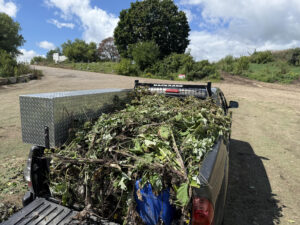
Another prime invader in the Acker Parcel prairies is burdock, a biennial plant which loves moist and nutrient rich soils. Unlike sweet clover, which was promoted and extensively cultivated, burdock spread across the US by its own thrift and volition. Despised by sheep, horse, and dog owners alike, burdock’s Velcro seeds are likely something you’ve run into. (A similar species, cocklebur, actually did inspire the invention of Velcro™.) Unfortunately, these seed heads are very dangerous for small birds and bats. The large seed stalks should be cut and composted before they fully develop to prevent them from going to seed and trapping critters. Burdock also possesses a massive taproot, especially in its second growing season. As a root vegetable, it’s called gobo and is widely consumed across Japan. This large taproot makes digging them quite the effort, as our Weed Warrior volunteers could attest after this season’s work. Volunteers from eGenesis joined us for a work event digging burdock as well. Burdock is most invasive in areas of low plant diversity with moist and rich soils. As these prairie plantings strengthen and native plant diversity develops, burdock’s impact should lessen significantly.
Pheasant Branch Conservancy contains a high-quality sedge meadow wetland complex, which is another critically rare habitat type in our state. This ecosystem, dominated by sedges, grasses and herbs, is fire-dependent and susceptible to invasive species like reed canary grass, purple loosestrife, hybrid cattail, and phragmites. In spring, large areas of reed canary grass were mowed and will be sprayed with a grass-specific herbicide this fall. This leaves sedge and herb diversity intact, and grasses like cordgrass, bluejoint, and fringed brome can be interseeded later.
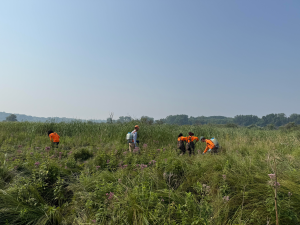
A highlight of wetland work was teaming up with Operation Fresh Start (OFS) and Quercus Land Stewardship Services for a cattail “mega-crew” day. OFS members cut countless cattails with powered saws and loppers, while Quercus technicians and I followed behind and applied aquatic-safe herbicides to the cut stems. Wet feet were had by most when all was said and done, but this work will help maintain the beautiful diversity of the sedge meadow. Herbicide is only one tool in the Integrated Pest Management toolkit and should always be used as a last resort in accordance with the product label’s requirements. Due to the laborious and often difficult nature of wetland work, Quercus is scheduled for additional days to continue controlling these invasives.
When managing invasive plant species, the goal is never simply eradication. The goal is to establish something in their place, ideally native vegetation for the sake of the ecological whole. Management efforts are only successful when they are integrated into a holistic system which supports biodiversity and habitat resiliency. Restoring frequent, low intensity fire in prairies, woods and wetlands is essential in building this ecological health and gives advantage to the fire-adapted ecosystems that once covered much of our state. For the benefit of these ecosystems, prescribed fires at Pheasant Branch will continue to be organized through experienced land stewardship professionals and enacted safely and smartly.
The collection and sowing of native seeds from native plant species is another essential element in this system of restoration. We’ve held seed collection volunteer events all summer and have more scheduled every other weekend until the end of October. A significant amount of these seeds will be spread in areas where invasives have been eliminated to establish native vegetation cover. Reinfestations will be identified and addressed in time, and the cycle will continue. It’s a repetitive dynamic process, and its fruits are borne in the wonderful richness of Pheasant Branch Conservancy.