By Janice P. Kehler, Friends of Pheasant Branch Conservancy Board Member
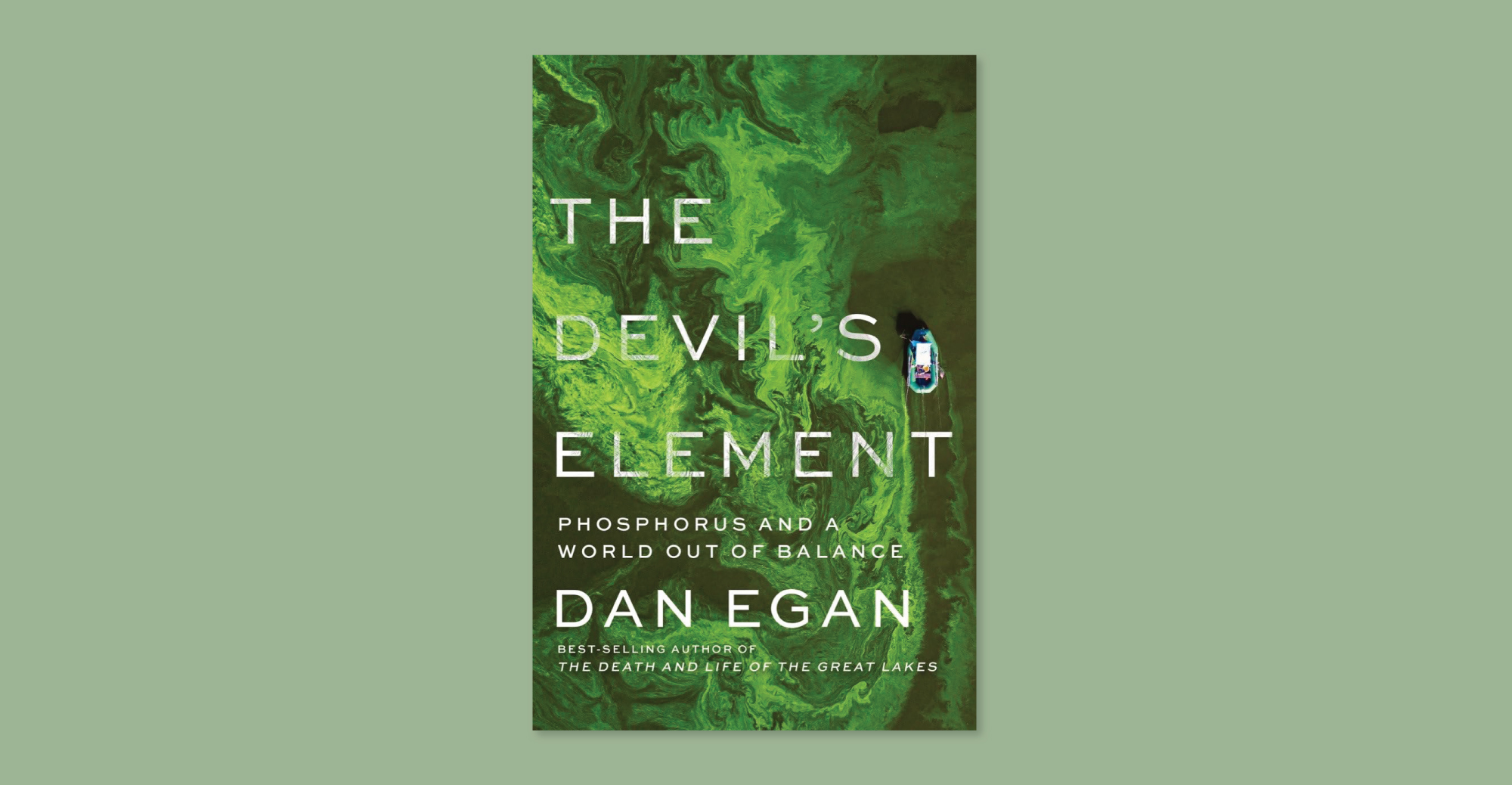
I’m always intrigued by a book’s title, a significant factor in determining what to read. Phosphorus, labeled by author Dan Egan, among others, a Devil’s element, contradicts the notion I had formed in college as a first-year student, curious about the biological sciences. I understood phosphorus to be part of the molecule vital to the production of energy that fuels the cellular processes of the human body. I had memorized a cycle of chemical reactions that produces our daily supply of energy—a life-giving story. The paradox, given what I knew and the provocative title, was irresistible. I was not disappointed. The book’s deep dive into the history of phosphorus fed my curiosity on every page. “The Devil’s Element” begins with its dramatic discovery in Hamburg, Germany, in 1669, and takes readers on a journey from past to present, from Hamburg to Florida, Lake Erie to the Western Sahara, and from the food on our table to the battlefield of Ukraine.
The book is divided into three parts: the race for phosphorus, its associated costs, and the future implications. It is a story that unfolds through a masterful, critical, sometimes humorous accounting of an element that is literally embedded in everyday life. Today, phosphorus is recognized as a “potent algae booster”, a danger that poisons our waterways, and yet, it is a vital biological nutrient for food growth that is being depleted faster than nature can replenish it—a world that is out of balance.
Egan reports many statistical factoids, including this: “…globally, roughly three million tons of phosphorus flow out the undersides of humans every year in the form of urine and feces.” The last chapter, entitled “Waste Not”, reports on progress being made to reclaim phosphorus in both human and animal waste streams. In the signature style of Egan, it is a meaningful account that travels from Green Bay, Wisconsin, to the University of Michigan and back to the discovery site of this thirteenth element of the periodic table, Hamburg, Germany.
“The Devil’s Element” it is a never-ending story that, by some twist of fate, begins and ends in Hamburg. It is a rewarding read that offers readers insight into a forward-looking solution to restoring the “overuse-scarcity” paradox that is the story of phosphorus.
Author Dan Eagan will be in conversation with John Reimer from the Dane County Land and Water Resources Department, discussing the never-ending story of the Devil’s Element, at the Friends’ Annual Membership Meeting on January 10, 2026
Lake City Books will have books available for purchase. Dan Egan will also be available to sign books after the meeting adjourns. This is a members-only event. Membership information can be found here.
Dan Egan for many years covered the Great Lakes for the Milwaukee Journal Sentinel. Now he writes occasional long-form pieces about climate change for national media outlets, including the New York Times, and is a senior water policy fellow at the University of Wisconsin-Milwaukee’s School of Freshwater Sciences.
He is the author of “The Devil’s Element: Phosphorous and a World Out of Balance” and the New York Times best-seller “The Death and Life of the Great Lakes”. Twice a finalist for the Pulitzer Prize, he has won the Alfred I. duPont–Columbia University Award, the John B. Oakes Award, the AAAS Kavli Science Journalism Award, and the J. Anthony Lukas Work-in-Progress Award.
A graduate of the Columbia Journalism School, he lives in Milwaukee with his wife and children.
 John Reimer is the Assistant Director of the Dane County Land and Water Department. John has a MS and PhD in Civil and Environmental Engineering from UW-Madison. His areas of expertise includes watershed management, lake level management, flood assessment, lake and river restoration, and stormwater management. He enjoys working on and communicating about complex water resources issues to improve Dane County’s sustainability and resilience to flooding and water quality problems.