
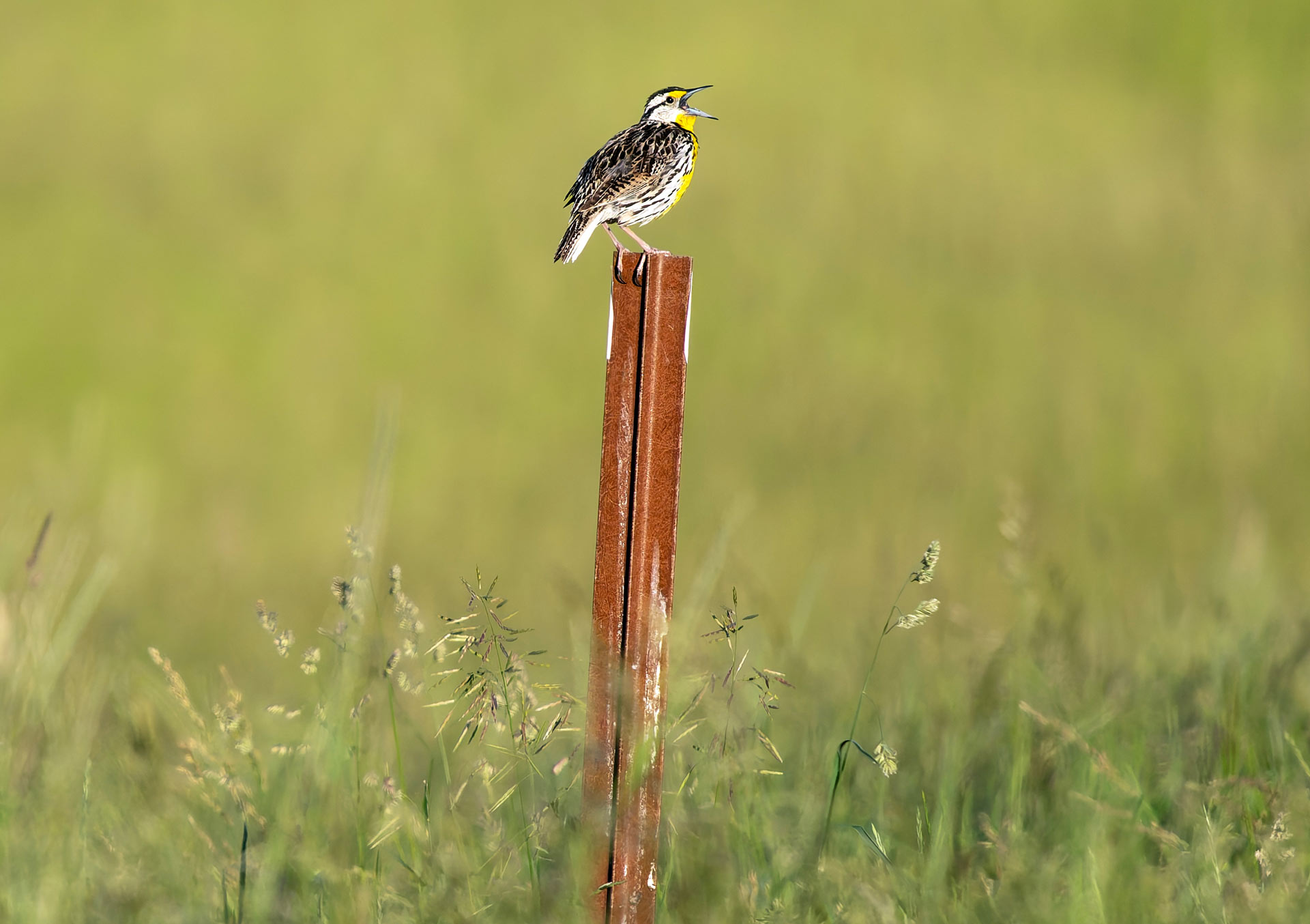
Photo of Eastern Meadowlark: Paul Ludden
By Peter Witucki, Friends of Pheasant Branch Conservancy Board Member
Across its 700 acres, Pheasant Branch Conservancy (PBC) protects important habitats, including restored oak savanna and prairies as well as a spring and wetland complex feeding into Lake Mendota. The Conservancy is home to rare and threatened animals, and an important rest stop for migrating birds.
Pheasant Branch Conservancy is also a place where many people find peace and solace in nature close to the heart of downtown Middleton. In 2022, the Conservancy was recognized as Madison Magazine’s “Best Running/Biking Trail.”
With all these different functions, this raises important questions about how–and for whom–Pheasant Branch Conservancy should be managed.
As we explore this idea, ask yourself:
- What exactly is a conservancy, and how is it different from a park?
- Both are public lands appreciated by visitors, but how are the management priorities different?
- Are there activities enjoyed in parks that would feel inappropriate in a conservancy?
- How do land managers balance the protection of wildlife with the importance of exposing visitors to the wonders of natural areas?
Pheasant Branch Conservancy is a complex of protected areas managed by Dane County Parks and the City of Middleton (technically, the Wisconsin Department of Natural Resources owns parcels as well). This complicates the question of ‘What is a conservancy?’. Fortunately, all these entities have a shared view regarding the designation and management of conservancy lands.
Middleton Parks defines conservancy lands as:
“natural areas managed for natural vegetation, habitat, water quality, and passive recreation. Trails provide access into and around conservancies, and facilities are generally limited to benches and waysides.”
Similarly, Dane County Parks considers natural resource areas like Pheasant Branch as:
“lands designated for the protection of a valuable natural environment, wildlife habitat, open space, and/or greenbelt corridor. Recreation at Natural Resource Areas is a secondary objective, with limited to no developed facilities–users are encouraged to enjoy the resource as is.”
In both cases, the land managers identify recreational access as a goal, but secondary to the protection of the natural resource.
Thinking about these questions helps us to recognize the multiple roles the Conservancy serves in our community and the need for continued protection of this special place. It also helps us better understand the conflicts that can arise from trying to balance multiple management goals and passionate constituencies! In the past, the Friends of Pheasant Branch Conservancy has attempted to mediate debates over accessibility and use, and some examples can be illustrative:
Dogs
For those of us who have had dogs in our lives, we know there is no bigger motivation to get outside and move than a dog eager for their exercise! But dogs–and particularly off-leash dogs–can be intimidating to other visitors and negatively impact protected wildlife.
PBC has a permissive dog policy compared to comparable properties; PBC allows leashed dogs on most trails and asks users to avoid ground nesting bird habitat during nesting season. By comparison, City of Madison Conservation Parks and the UW Arboretum strictly prohibit dogs.
To maintain the current policy, the Friends urge visitors with dogs to responsibly follow the guidelines.
Bikes
Bicycles are permitted on paved and crushed limestone paths and prohibited on grass and dirt trails. This opens large areas of the Conservancy to access by bicycle while maintaining sensitive habitat, hiking trails, and fragile trail surface from disturbance.
The Conservancy’s bicycle policy is also permissive compared to other properties. City of Madison Conservation Parks prohibit bicycles. The UW Arboretum restricts bicycles to roadways only. The UW Lakeshore Preserve limits bikes to the main multiuse path, having removed bicycle access to Picnic Point trails.
Cyclists are urged to only use the bicycle routes in PBC and to be cognizant of the many other Conservancy users sharing the path.
E-mobility
Dane County Parks and the City of Middleton do not have policies restricting the use of e-bikes, e-scooters, one-wheels, and other electric mobility devices, but this is a topic of concern among land managers and municipalities everywhere.
These devices can make experiencing PBC more accessible to folks with mobility challenges, but irresponsible use is dangerous and disruptive.
E-mobility users should follow the land managers’ bicycle guidance, remembering that some of these vehicles are faster and heavier than traditional bicycles, posing an increased risk.
Paved vs. Natural surface trails
Accessibility advocates and some cyclists have argued for paving some or all the paths in the Conservancy to afford access to visitors with limited mobility and to expand bicycle commuting options in the region. This has been a contentious issue over many years and merits a much longer discussion. For the purposes of thinking about ‘What is a conservancy?’, the questions raised are illustrative of the challenges facing land managers:
- How does designating a bike commuter corridor through PBC affect the conservation mission of the Conservancy? What impact would higher vehicle speeds and increased bike traffic have on other users? Is promoting healthier, greener transportation options in alignment with our conservation mission?
- What is the responsibility of land managers to make parts of the Conservancy accessible to all members of the community? How do we balance the ethical responsibility of access with habitat impacts?
There are no easy–or right–answers to any of these questions about how and for whom a conservancy should be managed. Although protection of the natural resource is a primary goal, it is also important to allow access to this resource for purposes of education, recreational activity, and promoting the feeling of joy and wonder experienced in this natural environment.
The Conservancy’s history illustrates the successes that can be achieved when all parties are able to find balance in their shared passion. Walkers, joggers and bicyclists share paths, dog owners enjoy exercise with their leashed buddies, and the Make a Memory Day Event provided access to members of our community with physical and cognitive challenges as the Friends partnered with advocates, caregivers, naturalists and volunteers to experience the Conservancy. At the same time, new plants are growing in the propagation garden, eagles are expanding their family, beavers are building homes, and eastern meadowlarks are nesting in the platinum prairie.
What is a conservancy? The answer, as applied to Pheasant Branch, is complicated. All the stakeholders in the debate over habitat protection, access, and use are engaged because we all recognize the value of Pheasant Branch Conservancy and are deeply invested in protecting this amazing work of nature that we have in our community.