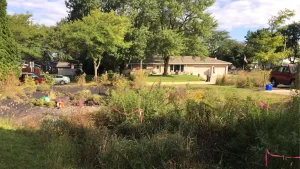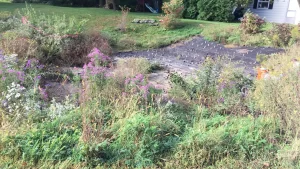
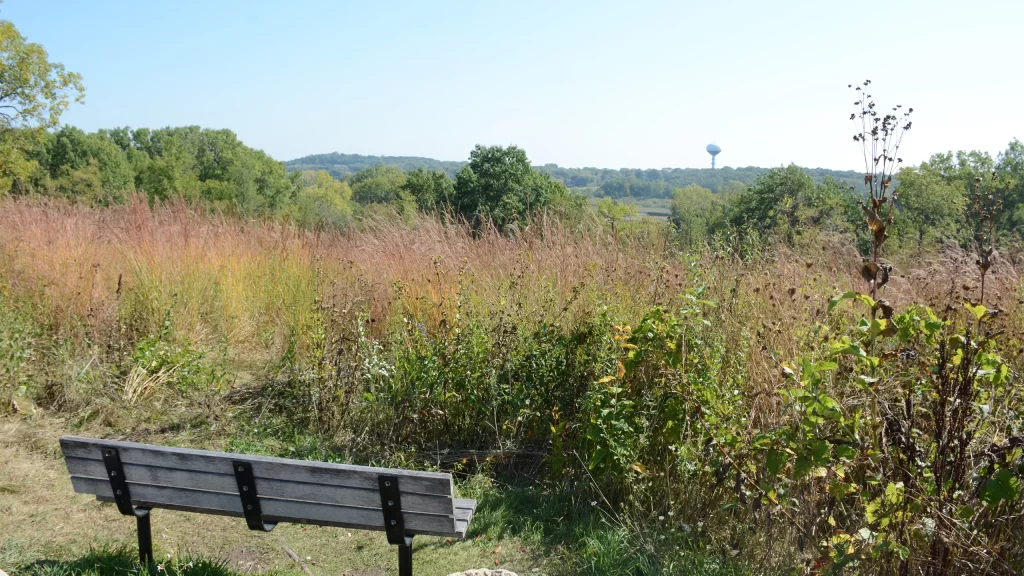
As a neighbor or property owner, you can play a special role in protecting the Conservancy.
Invasive plants pose a threat to the Pheasant Branch Conservancy.
Invasive plants can disrupt or degrade diversity and function of an ecosystem resulting in simplified and less resilient plant communities.
While land managers and volunteers spend time and resources to remove invasive plants from the Conservancy, their efforts can be hampered by neighboring properties that harbor the very species they are targeting.
Invasive plants can easily move across the landscape. Birds and other animals eat seeds and deposit them in their droppings. Wind carries fluffy and winged seeds great distances. Any time soil is moved by stormwater or construction projects, seeds and plant parts will also be moved. Even mowing can spread seeds and other plant parts.
Check your property. If you find one of these species remove it and replace it with one of the beautiful and beneficial alternative plants.
A local plant nursery can also help you find an appropriate replacement plant.
Janet Kane, a Friends’ Restoration and Management Committee member, and Rob Schubert, former Pheasant Branch Conservancy Land Manager, worked with Bryn Scriver, Wisconsin Master Naturalist (FOPBC class of 2019) to put together this brochure. If you’d like a copy, e-mail our restoration committee with your mailing address. Thanks for your interest in conservancy lands.
Additional Resources
- Wisconsin DNR’s website, www.dnr.wi.us. Recommended search terms: Euonymus, Common buckthorn, Eurasian bush honeysuckle
- Wisconsin First Detector Network (WIFDN), fyi.extension.wisc.edu/wifdn. On the right side, click on “Access fact sheets and ID videos” and scroll down to Terrestrial Plants. Get fact sheets for Bird’s-foot trefoil, Buckthorns, Bush honeysuckles/Japanese honeysuckle, Crown vetch
- The Invasive Plant Atlas of the United States, invasiveplantatlas.org. Click on the tabs (Grasses, Herbs/Forbs, Shrubs/Subshrubs). The plants are arranged alphabetically by scientific name – Grasses – Miscanthus sinensis Herbs/Forbs – Lotus corniculatus, Securigera varia Shrubs/Subshrubs – Euonymus alatus, Euonymus europaeus, Lonicera (various species), Rhamnus cathartica
- Invasive Plants Association of Wisconsin, www.ipaw.org.
Books and Guides
- A Field Guide to Terrestrial Invasive Plants in Wisconsin: Edited by Thomas Boos, Kelly Kearns, Courtney LeClair, Brendon Panke, Bryn Scriver, and Bernadette Williams, Wisconsin DNR, 2012
- Native Alternatives to Invasive Plants: C. Colston Burrell, Brooklyn Botanic Garden, 2011
- Invasive Plants of the Upper Midwest: An Illustrated Guide to Their Identification and Control: Elizabeth Czarapata, University of Wisconsin Press, 2005
- UW-Madison Arboretum Native Plant Garden and Native Gardening Conference: 1207 Seminole Highway, Madison, WI
Related Articles
What is a Conservancy?
What’s the difference between a park and a conservancy? How are each managed? Take a deeper dive and learn more about what the Friends do.
Learn More →
Conservancy Days: Connecting Community, Conservation & Place
Join us at the Middleton Public Library every other month for a series of educational events where you’ll learn all about Pheasant Branch Conservancy.
Learn More →
Backyard Conservancies – Go Native
Protecting and enhancing areas like Pheasant Branch Conservancy requires us to adopt a conservation ethic at home–beginning with native landscaping.
Learn More →