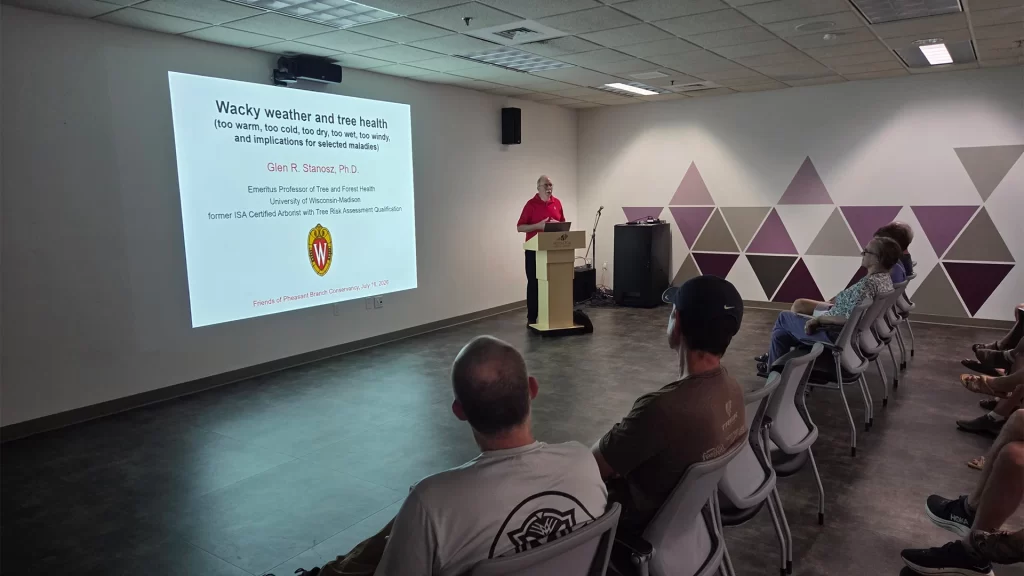
What does Wisconsin’s increasingly unpredictable weather mean for the trees in our forests, parks, and yards? UW–Madison Professor Emeritus Glen Stanosz explored that question during the July 17 Conservancy Days presentation, “Wacky Weather and Tree Health.”
Stanosz is a forest pathologist—a biologist who studies tree diseases—with particular expertise in fungi. He explained that “wacky weather” is a deliberately approachable way to discuss climate change. Terms such as “climate change” and “global warming” can cause some people to tune out, while nearly everyone has noticed that Wisconsin’s weather does not always behave the way it once did.
Those changes include warmer temperatures, especially during winter, along with heavier rainfall, more flooding, and less consistent snow cover. Such conditions can place trees under considerable stress, particularly when they are adapted to the climate patterns Wisconsin experienced in the past.
One example involves winter hardening. During autumn, gradually cooling temperatures signal trees to prepare for freezing conditions. Their tissues undergo changes that allow them to survive the cold. If fall remains unusually warm, trees may not become fully hardened before freezing weather arrives.
Warm spells in late winter or early spring can create the opposite problem. Trees may begin to “deharden,” losing some of their resistance to freezing temperatures. If a late cold snap follows, buds, leaves, shoots, and other vulnerable tissues may be injured.
Changes in snowfall can also affect trees. Although snow may seem like an additional winter burden, a dependable snowpack insulates the soil and protects roots from extreme temperature fluctuations. With less snow and more frequent cycles of freezing and thawing, roots may experience greater stress.
Heavy rain and flooding present another challenge. Saturated soil contains less oxygen, making it difficult for roots to function. Floodwater can also damage roots, erode soil, and leave trees more vulnerable to insects and disease. At the same time, periods of intense rainfall do not necessarily eliminate the danger of drought, especially when water runs off quickly instead of soaking into the ground.
Weather-related damage may not kill a tree by itself, but it can weaken the tree’s natural defenses. That is where fungi and other disease-causing organisms enter the picture. Stanosz emphasized that potentially harmful fungi are common in the environment. Many wait for an opportunity to infect a tree that has already been weakened by flooding, drought, root damage, winter injury, or another form of stress.
Fungi can enter through damaged bark, broken branches, injured roots, or tissues harmed by frost. Once established, different fungi may cause cankers, wood decay, vascular diseases, or root rot. Tree decline is therefore often not the result of one easily identifiable cause. It may begin with unusual weather and then accelerate as fungi, insects, and additional environmental pressures take advantage of the weakened tree.
Stanosz also discussed what homeowners can—and cannot—do when trees show signs of trouble. Frost-damaged leaves or shoots may look alarming, but they do not always indicate that the entire tree is in danger. In some cases, the best response is patience, along with reducing further stress by watering appropriately, protecting roots, and avoiding unnecessary pruning or injury.
Suspected fungal infections require careful diagnosis. Mushrooms, discolored leaves, dead branches, cracked bark, or a thinning canopy can have many possible causes. Treating the wrong problem may waste money or even further harm the tree. Depending on the diagnosis, appropriate responses might include removing infected branches, improving drainage, avoiding injury to trunks and roots, or consulting a certified arborist. Fungicides are useful only in certain situations and are not a universal cure for tree disease.
The presentation offered an important reminder that trees are long-lived organisms facing rapidly changing conditions. Healthy trees are generally better able to resist disease, but even vigorous trees can struggle when extreme weather events occur repeatedly. Maintaining healthy trees and forests will increasingly require close observation, thoughtful care, and an understanding that weather, fungi, insects, and other stresses often work together.
Our next Conservancy Days program will be held on September 17. Paul Ludden will return to take us on a photographic tour comparing the ecosystems of Pheasant Branch Conservancy with those of Costa Rica. Through his photographs, Ludden will explore both the striking differences and unexpected connections between these two remarkable landscapes.
Related Articles
The Benefits of Using Native Plants & Rain Gardens
Two recent workshops showed residents how rain gardens and “going native” with plantings can help their yards and the community.
Learn More →

Bringing the Outside….Inside
The Friends’ Education Committee continues to provide season-related programs to the residents at Attic Angels Community Memory Care.
Learn More →
New Advances in Monarch Butterfly Tracking
Learn how changes in butterfly monitoring could affect monarch tagging events at Pheasant Branch Conservancy.
Learn More →